



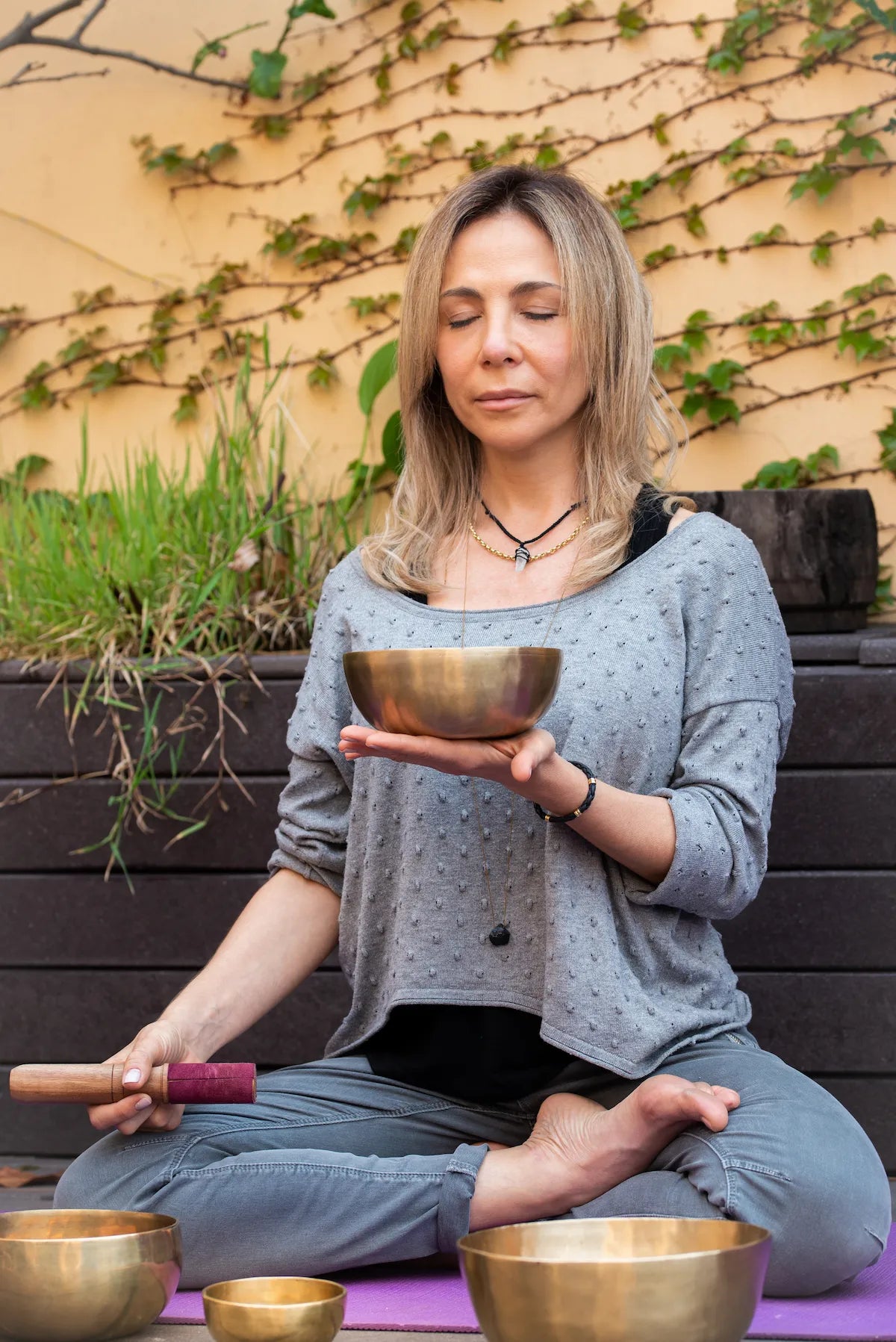
Tibetan singing bowls are primarily associated with relaxation and stress reduction. Recent reviews suggest potential effects on anxiety, mood and the nervous system, although no definitive clinical conclusions can yet be drawn. But their benefits depend less on the object itself than on how it is used: hearing the sound or physically feeling its vibration in the body.
You have probably heard many claims. That a particular singing bowl “aligns your chakras,” rebalances a specific chakra, or that a certain note “heals” a particular organ. After more than twenty years working with these instruments, allow me to put things back into perspective — without taking anything away from their beauty. Tibetan singing bowls have real effects. But those effects are not necessarily the ones people speak about most loudly. And they depend greatly on how the bowls are used.
Where do Tibetan Singing Bowls come from?
To understand what a bowl can offer, we first need to understand the instrument itself. The historical origins of what are now sold as “Tibetan bowls” or “singing bowls” remain debated. Today, they are strongly associated with the Himalayan region and are widely made in Nepal and India — our bowls are made in India — but accounts attributing an ancient Tibetan ritual use to them are not firmly documented.
Their history is intertwined with legend. They are said to be made from seven sacred metals — gold, silver, copper, tin, iron, lead and mercury — each associated with a celestial body. The metallurgical reality is more straightforward: most are made from a bronze alloy, primarily copper and tin, sometimes with traces of silver, iron or lead.
What matters is not the myth, but how the bowl is made. When a bowl is handcrafted and hammered from heated metal, this process gradually modifies the structure of the metal and contributes to its ability to vibrate and produce a long-lasting sound. Hammering also creates slight irregularities in the bowl's shape. As I explored in my university thesis on singing bowls and Music Therapy, these irregularities contribute to the instrument's acoustic richness and can generate beats or pulsations that enhance the enveloping, hypnotic quality of the sound.
This artisanal manufacturing process creates a genuine musical instrument with a rich, living and sustained voice. It is far more than a decorative object: in the hands of a practitioner who knows how to use it, it can become a genuine tool for care.
The benefits commonly attributed to Tibetan Singing Bowls
Now to what everyone wants to know. But first, we need to distinguish between what is attributed to these instruments and what has actually been established. These are the effects most commonly reported by people who use singing bowls or participate in sessions.
Physically, some people report a release of muscular tension, a feeling of bodily relaxation and sometimes a reduction in perceived pain. Emotionally, they often describe a sense of calm and reduced stress. Mentally, they may experience a calmer, more receptive state of attention that can help facilitate entry into a deep meditative state.
When using a Tibetan singing bowl, physical and emotional effects are often described together. Many people describe a whole-body experience, both physical and emotional, with a sense of balance — sometimes emotional balance — as though the sound wave could help release tension, fatigue or the sense of excess energy that so many people carry.
Some describe this experience in terms of “energy,” circulation or release. This energetic vocabulary is common; I mention it without taking a position on it, because subjective experience has value without presenting these concepts as established physiological mechanisms.
When used appropriately, a singing bowl can enhance perceived well-being and encourage relaxation. Tibetan singing bowls therefore have a genuine place in practices aimed at promoting relaxation and reducing stress — provided we do not promise more than they can deliver. The benefits of singing bowls, ultimately, deserve to be described accurately.
What does the research actually say?
We need to be honest and precise here, because this is a health-related subject. Research is progressing, but it is still young.
A 2025 systematic review (Lin, Yang & Wang, Healthcare, MDPI) brought together fourteen quantitative studies. Most reported favourable results relating to anxiety, depressive symptoms, well-being and certain physiological markers, including heart rate variability and heart rate. However, the authors also emphasised the heterogeneity of the studies and the still limited body of available research. Another 2025 review (Cai et al., Integrative Medicine Research) analysed nineteen clinical studies involving different populations and conditions. It also identified encouraging findings concerning anxiety, depression, sleep and certain physiological and cognitive functions, but the quality and diversity of the available studies do not yet allow definitive clinical conclusions to be drawn.
The important word here is may. The available studies show encouraging signals, but protocols remain heterogeneous and the evidence is still limited. In other words: promising results, not definitive proof. That distinction is precisely where honesty — and genuine respect for the reader — lies.
How can sound help the body relax?
One of the most credible explanations involves the relaxation response and the activity of the autonomic nervous system, particularly its parasympathetic component — associated with rest and recovery.
When sound is slow, enveloping and non-threatening — without abrupt interruptions or sudden changes in intensity that could trigger a startle response — it may help create a sense of safety and reduce alertness. Breathing may slow, heart rate may change, and the body can gradually enter a more relaxed state. This is known as the “relaxation response,” which is also observed in certain meditation practices.
But sound does not act mechanically: how it is perceived matters just as much as its acoustic characteristics. The way the instrument is played is therefore essential. Listening to the other person, gradually building intensity and avoiding sound stimuli that may trigger a startle response are among the principles we work with in our training programmes through a technique we call “anxiolytic musical improvisation.”
Tibetan singing bowls are particularly well suited to this type of listening. Their harmonic richness, sustained resonance and the beats or pulsations that can be perceived within their sound provide a gentle focus for attention and may help facilitate a sometimes profound state of relaxation.
Tibetan Singing Bowls and sleep: what can you really expect?
This is one of the most common expectations — and one of the most delicate. Many people look for a Tibetan singing bowl for better sleep, hoping to fall asleep faster or sleep more deeply. What can we honestly say?
Let's be clear: to date, very few studies have focused directly on sleep, and the available evidence does not allow us to claim that a Tibetan singing bowl on its own improves sleep quality. We should therefore remain cautious. What is more plausible concerns the context it can help create: a short sound ritual or singing bowl meditation before bedtime may help reduce alertness, slow the breath and gradually prepare the body for sleep. A Tibetan singing bowl does not act like a sleeping pill, but it can accompany the transition from activity to rest.
In practice, a few minutes of listening — or even a few minutes spent playing Tibetan singing bowls in a meditative state — can already provide an interesting bedtime ritual: gentle, spaced sounds at a low volume, in a calm environment with as little stimulation as possible. Here again, how the instrument is played matters just as much as the instrument itself.
But listening to a sound and feeling a vibration directly in the body are two different experiences. It is precisely this second pathway that we explore in vibroacoustic therapy, including with the Viset Pillow®, which uses low-frequency sound vibrations to accompany moments of relaxation and rest.
Hearing is not the same as feeling: the difference that changes everything
This is where I want to be very clear, because this distinction lies at the heart of our approach at Vibroacustica School.
When a Tibetan singing bowl is played at a distance, the experience is primarily auditory: we listen to the sound, its harmonics, its beats and how it evolves over time. But when certain types of bowls are placed directly on the body, the experience changes: the sound is no longer only heard; its mechanical vibration is also transmitted through contact and physically felt.
This is one of the principles of Sound Massage with vibroacoustic singing bowls. The vibration is transmitted through the area of the body in contact with the bowl and can be perceived well beyond the auditory phenomenon alone. The quality of this experience, however, depends on many factors: the size and characteristics of the bowl, how it is played, the intensity of the vibration, where it is placed on the body and, of course, the person receiving it.
It is also important to distinguish Sound Massage from vibroacoustic therapy. Both use sound vibration felt by the body, but they do so differently. In vibroacoustic therapy, we work with low-frequency vibrations transmitted directly to the body using devices specifically designed for this purpose. This allows greater control over frequencies and stimulation parameters and, above all, makes it possible to work with much lower frequencies than a singing bowl can generally produce.
This is precisely the complementarity we explore in our approach: listening to sound and feeling vibration are two different dimensions of the sound experience. Singing bowls allow us to work with both, depending on how they are used, while vibroacoustic devices, such as our Viset Pillow®, allow us to work specifically with the bodily transmission of low frequencies.
How to use a Tibetan Singing Bowl in everyday life
The effects depend largely on how the instrument is used. How should you use a Tibetan singing bowl depending on your intention? Three main approaches can be explored, either separately or within the same practice:
-
Listen to it — during a singing bowl sound bath, alone or in a group: the bowl is played at a distance and the experience is primarily auditory.
-
Meditate using a Tibetan singing bowl — a few sounds can accompany the transition into meditation, support attention and then make space for silence.
-
Feel it — certain bowls can be placed directly on the body so that their vibration is physically transmitted, as in Sound Massage.
This simplicity is one of its strengths: no complex training is required to produce your first sounds or begin exploring the instrument. Whether you want to strike the bowl for meditation or place it on your body for a longer session, regular practice is key. The choice of musical instrument, however, matters just as much as how it is used — including its size, weight and alloy. If you would like to explore this further, we explain it in detail in our guide to choosing a singing bowl according to its intended use.
How do you make a Tibetan Singing Bowl sing?
There are two main ways to make a Tibetan singing bowl sing: gently striking it with an appropriate mallet and allowing the sound to unfold and resonate; or slowly rubbing the rim of the bowl with a leather-covered mallet in a circular motion, sustaining the vibration and creating a continuous sound, like a long breath.
With the second technique, the resulting sound depends greatly on the movement. The pressure applied to the rim, the speed of the movement and the type of leather used can bring out different frequencies and produce lower or higher tones. Making a bowl sing is therefore not simply a matter of moving a mallet around its rim: the way you play it genuinely transforms the sound of the instrument.
Producing your first sound with a Tibetan singing bowl is relatively simple. Learning to use it well, however, requires developing your listening skills, sensitivity of movement and a certain degree of control over intensity. This becomes particularly important when the bowl is used on another person or directly on the body.
The choice of instrument also matters: its size, weight, shape and acoustic characteristics partly determine the ways in which it can be used. If you would like to explore this further, we explain it in detail in our guide to choosing a singing bowl according to its intended use.In Summary: Real Effects, as Long as We Are Honest About Them
Tibetan singing bowls deserve better than the claims that surround them. What they can genuinely offer — encouraging relaxation, supporting attention, accompanying meditation and, depending on how they are used, allowing vibration to be felt directly in the body — does not need to be exaggerated to have value.
If you would like to explore these singing bowls, browse our selection of Tibetan singing bowls. And if you would like to go further, understand how to use them and integrate sound and vibration into a genuine practice, discover our Sound Vibration Work® training. The rest, as always, is discovered in the silence that follows the sound.
Your questions about Tibetan Singing Bowl benefits
Can Tibetan singing bowls treat an illness?
No. No serious study currently provides evidence that Tibetan singing bowls can treat an illness, and claims suggesting otherwise should be approached with caution. They can, however, accompany relaxation, meditation and stress management — as a complement, never as a replacement for medical care when it is needed.
How long does it take to feel the effects?
Some people experience relaxation during their first session, sometimes after only a few minutes of listening. But the experience varies considerably from one person to another, and there is no specific amount of time after which effects can be expected to appear. As with meditation, regular practice may also gradually develop greater familiarity with listening, silence and bodily sensations.
Do you have to believe in It for It to Work?
No. You do not need to believe in any particular properties of Tibetan singing bowls to experience the sound, vibration or a state of relaxation. But the experience is not purely mechanical either: a person's receptiveness, their state at that particular moment, the way the bowl is played and a reassuring environment can all influence how the sound is perceived and experienced.
Hearing the bowl or feeling the vibration: what's the difference?
When a bowl is played at a distance, the experience is primarily auditory. When a suitable bowl is placed on the body, its mechanical vibration can also be transmitted through contact and physically felt. Vibroacoustic therapy goes further along this second pathway by using devices designed to transmit low frequencies to the body in a controlled way. This is not necessarily a “deeper” effect, but rather a different way of working with sound and vibration.
Share:
The Viset Pillow: a science-based technology